By Brody Hale
I don’t suspect there is a patron saint for Catholic church preservation. If I am correct, then I can think of none better than St. Francis of Assisi to fill this role. In the last twenty-one months, a great deal of interest has been shown in all things related to this humble Italian friar, since our current holy father became the first pontiff to take this name. Much has been made of the pope’s willingness to look at new ways of doing things; and while this could be argued as reason enough to claim Francis as patron saint for a cause which seeks to change traditionally held views on the closure of Catholic churches, I do not believe it is the main reason for doing so. During the course of his life, St. Francis of Assisi dealt with the issue of restoring the church, both physically and spiritually, and it was my connection to a church dedicated to his patronage which kindled within me a desire to help insure God’s houses aren’t cast aside like warn out shoes.
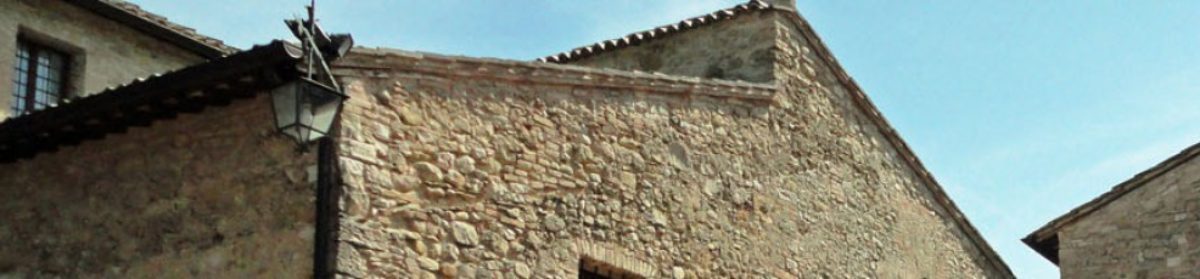
If one looks at the cover photo to the Catholic Church Preservation Society website, they will see a picture of the Church of San Damiano, located near Assisi. It was at this church that Francis began his work of rejuvenating the church, a mission which the Franciscans carry on now more than 800 years later. In 1205, Christ appeared to Francis, and told him to “go repair my church, which as you see is falling completely in ruin.” [i] Francis then set about making repairs to the Church of San Damiano, which had as Christ said, fallen into a very severe state of disrepair.
We all know that Christ was truly asking Francis to undertake a project of more universal repair to the Catholic Church itself, which was plagued with a multitude of difficulties at that time. Never the less, it is unquestionably the case that Francis’ repairs to the Church of San Damiano served a tangibly good purpose which furthered the mission of the church, and did in fact carry out Christ’s message in and of themselves. Given the state of disrepair which the Church of San Damiano was in at the time of St. Francis’ visit, it is unlikely that this house of God was in much of a position to serve as the site for the sacred activities which a church is designed to host. Following St. Francis’s repairs to the church, it again could perform its function well, and in so doing, provide yet another location for the Catholic faithful to enter a sacred space, and participate in those activities which are especially suited to be conducted in a church, i.e. private prayer and the celebration of the sacraments. Church buildings in a state of disrepair cannot be said to be in the state of being in which they are best able to function as God’s houses on earth. Thus, I can think of no better Patron saint for all of those individuals and groups of people around the United States who tirelessly work to maintain Catholic church buildings at their own expense, in order that they might still be sites of private prayer and occasional masses. It is the inspiration I take from St. Francis’ work to restore the Church of San Damiano and the church universal that has led me to dedicate all of my work to him.
There is also for me however a far more personal connection between St. Francis of Assisi and the issues surrounding the preservation of Catholic church buildings as sacred spaces. I was a member of the fifth generation of my family to call St. Francis of Assisi Church in South Lee MA, located within the boundaries of the Diocese of Springfield, my spiritual home. St. Francis of Assisi church in South Lee was not a grand church by any stretch of the imagination. Its interior was not replete with frescos painted by any master craftsman, or frescoes of any type for that matter. It was not an example of a rare and exceedingly appreciated architectural style, I think simple plain small-town church would best sum up the architectural school into which it fell. Its interior was not cavernous; its pews allowed for 144 persons to be seated, and you might have been able to fit another half dozen in folding chairs in the sacristy. After the furnace exploded in 1988, sending smoke and soot through the heat registers into the sanctuary and nave, the church always had a certain Oder to it when you walked through the doors, which my mother referred to as “the St. Francis smell.” It was thus like most any church any reader of this essay might belong to, important for above all else the spiritual nourishment and comfort received within its walls, and the attachment its parishioners had to it, often growing out of deep family ties.
Since my great-great grandparents assisted with its construction in 1882, St. Francis served as the church at which all of my family’s most significant life events took place. It was where my great-grandparents, grandparents, and mother were baptized, received first communion, and married. It was where my grandmother’s funeral was held, when my mother was fourteen years old. St. Francis of Assisi church was the place in which I received my formative years of religious education (my mother was one of the instructors,) and it was the site of my baptism and first communion. I came to understand and believe in the Catholic faith at St. Francis Church, and I suspect the same is true for countless others during the course of the church’s history. On a more sentimental level, the church will forever be associated with memories of me helping my mother decorate it before Christmas, and take down decorations after Epiphany. In short, it was a constant presence in the lives of my family members for nearly a century and a quarter.
St. Francis parishioners were a self-sufficient bunch. There were as far as I am aware, no paid employees at the church. The organist and several others doubled as the lawn mowing and snow shoveling crew, and the choir members, religious education teachers and all others served without pay. When someone truly went above and beyond the call of duty, a church member who noticed might go to the local pharmacy and buy them a large box of Russell Stover chocolates, at their own expense, as a show of appreciation for their efforts. Upon hearing of the gesture, a few others, feeling they should have been the ones to notice the good deed and buy the candy, might chip in and help defray the cost of the chocolates. The members of the St. Francis congregation, like surely most every other Catholic Church congregation, joined together to live the Christian message in the care of their place of worship and their fellow worshipers.
I was I must confess, not the most happy mass goer as a small child. I vividly remember one Easter, when I was 3 years old, asking my mother why I had to go to church? I had an Easter basket full of candy in front of me, and I had no desire to be pulled away from it! When I was a year or two older, there was nothing I hated more than going to St. Francis on a hot Sunday morning, and enduring mass without air conditioning (air conditioning was never installed at St. Francis church,) not really understanding what mass was in any case. Why was I listening to some man talk for an hour, and everyone else sing songs about “God?” This was one question I asked, along with why all the adults lined up and went up to eat bread near the end!
The drafters of the Code of Canon Law seem to have been some very smart people! I say this, as around the time when I achieved what is called in many commentaries on canon law to be “the age of reason,” I began to have an appreciation of how special it was for me to be at St. Francis of Assisi Church, as that was where I was closest to God. When I began to understand who God was, who Jesus was, what Catholicism was, the meaning of the sacraments, and the inherently sacred character of the church building itself, there was literally no place in life I would rather have been than at church. I became an altar boy at age 10, and served in that role until the church closed over a decade later. I ate up the content of my religious education classes, quizzing my teachers on obscure questions in order that I might better understand the faith, and in so doing, incurring the wrath of a good percentage of my classmates by causing class to often end late!
Some of the most vivid memories of my formative and teenage years are those of events which took place at St. Francis. Christmas Eve mass at the church was a truly special occasion, both in the years of my early youth and later when I served as an altar boy. I always felt as if I was able to gaze back through time as I heard the chant from the Roman Martyroligy which proclaims Christ’s Nativity intoned. Every time it ended with the announcement of the birth of Christ; I felt as if I was hearing the glorious news for the first time all over again. I loved seeing my grandparents and opening presents later in the evening (we usually opened their presents on Christmas Eve and Santa’s presents on Christmas Morning,) but I knew that the most important part of Christmas was celebrating the birth of the son of God. Palm Sunday, and the processions which we had from the fire house parking lot next to the church to our pews, holding the blessed palms, followed by the passion play, came to have a greater importance for me as well, following Palm Sunday in the year 2000. The previous night, I had attended a “lock in,” an all-night party and dance at the high school where I was a freshman, to raise money for the National Honor Society. It had been incredibly fun, and I have memories of that evening which will last a lifetime. I didn’t get home until after 6:00 A.M., and I think it is thus easy to understand why I was quite tired at that point. At around 9:30, my mother for whatever reason came in and told me she was leaving for church. I remember thinking that even with only around three hours of sleep under my belt, I ought to be leaving for church also. She protested that I was in no condition to serve mass, a fact I could not disagree with (for the record I hadn’t consumed anything the night before, I was just very tired,) but I climbed out of bed and began to dress. I remember walking from the fire house parking lot into church, and forcing myself to stay awake through the passion play and the rest of the mass (which I did successfully,) and thinking as I sat there that any pain I was feeling paled compared to that experienced by Jesus during the crucifixion. Thus, Palm Sunday of 2000 at St. Francis Church was the day when suffering was placed in perspective for me, and I learned how wonderful it can feel to put aside your own comfort to serve Christ.
St. Francis was always a “mission” of another parish. The parish to which it was attached changed several times over the years, but in the early 2000s, it was St. Mary, Mother of the Church parish, the other Catholic Church in Lee which oversaw St. Francis. It was in the early 2000s that the seeds of the reorganization of parishes, a process which continues to sadly lead to the needless closure of Catholic church buildings within the Roman Catholic Diocese of Springfield MA began to be sewn. On June 8, 2003, my mother and I were asked to stay after mass for a “meeting,” because there was a plan to “close” St. Francis church. I will never forget the feeling I felt when I heard the words “close the church” that Sunday morning. It was as if someone were speaking in some unintelligible dialect. I could not understand how it was that a church which was full every Sunday, which cost the diocese and parish in which it was located nothing to maintain, and which had sufficient cash reserves in its bank accounts to meet the cost of any needed repairs would be considered for closure. I further couldn’t understand how any Catholic church could be closed, I never knew such a thing was even possible. How could you take God out of a church? This was the question I wondered as I sat through mass that late spring morning, just days from my high school graduation.
I of course knew nothing about the massive waves of church closures which had swept through the Archdioceses of Chicago and Detroit or about the reorganization plan which was steadily eating away at the number of churches remaining within the Diocese of Pittsburgh. I only knew that the Code of Canon Law was some sort of administrative code; I had no idea as to how it worked. I didn’t know about the differences between parishes and churches, that each had different rights under canon law, and that parishioners had any rights to speak of within the Roman Catholic Church in the first place. I knew that church politics could be messy; we had been battling with parish administration to get approval to repair St. Francis’ deteriorating slate roof, at our own expense for years, permission which never would come. Realizing that closure was something which in fact could happen, a group of us decided to meet the following Friday to figure out a way to save the church.
It was in this context that on a cold and rainy Friday June 13 at 7:00 P.M., the night before my high school graduation, my mother and I stepped away from graduation party planning and joined a number of other parishioners inside of St. Francis church to figure out how to prevent what still seemed like an impossibility from actually coming to pass. We came up with several arguments during that 11/2 hour meeting for use at the full parish meeting in the St. Mary’s School auditorium scheduled to occur nearly two weeks later, arguments which we never ended up needing to use. We were told at that meeting that the plan to close St. Francis Church had been shelved for the time being, and that no one need worry about that contingency. I figured this church closure idea had been someone’s crazy plan, and that it had rightfully been shot down, never to resurface. My innocence regarding church closures was sadly short lived. I was about to leave for college, a period of my life which would place me within the boundaries of the Archdiocese of Boston. It was in the Boston Archdiocese, a place which has sadly become associated with dysfunction and pain in the minds of many Catholics following a number of scandals and less than well thought out and even more poorly implemented church closure plans, that I tasted the cold truth of how unchristian this holy church can sometimes be.
My experiences in the Archdiocese of Boston and my observation of the implementation of its 2004 parish reconfiguration plan warrant an essay of their own, something I hope to write and post in the coming weeks. For now, it suffices to say that by the summer of 2005 I had become fully aware from witnessing the train wreck that was that Boston archdiocesan parish closure program that church closings were very real, very painful, and in many cases, quite counterproductive on account of the damage which stems from them. It was that summer when talk again resurfaced in earnest that St. Francis church should be closed. It was absolutely the case at that time that St. Mary’s parish was running a deficit (my mother was on the finance committee; if anyone challenges me on this point I’ll dig out the financial report and post it here.) There were those within St. Mary’s parish that saw an opportunity to clear a portion of that deficit by selling off St. Francis church, and applying the money to the shortfall. I won’t say whether this was the pastor’s belief as well; I cannot read his mind and I won’t presume to know his thoughts. What I can say is that at 10:00 on the Friday morning of July 22, 2005, after rumors had circulated for weeks that St. Francis church would be closed, neither confirmed or denied by St. Mary’s parish administration, a group of parishioners including me and my mother met with our pastor, Fr. Daniel Papineau. He made it clear at that meeting that as he was being given the responsibility of caring for another church, St. Joseph’s in the town of Stockbridge, St. Francis would be closed. To say that he was unwilling to consider alternatives would be a massive understatement; his mind was quite made up on the fact that St. Francis church needed to go. He would not however provide a time table on when this closure would be carried out; he merely said it would be discussed later.
It was while still weighing my options as to how to proceed that on Sunday August 28 it was announced that St. Francis church would close “temporarily,” while the priest who usually celebrated mass at the church went on vacation. After the mass, I asked that priest, now-Msgr. John J. Bonzagni, why he was removing his chalice from the church, something he had never done previously when he would be away for a short time, if he was going “on vacation.” I also asked him why a note had been discovered in the sacristy which took the form of a list of all of the scheduled masses which were to be celebrated with intensions at the church into 2006, which had been circled, with the words “these must be changed” written across the list. He couldn’t, or wouldn’t answer the questions, and it was at that point that I suspected something less than above board was taking place. After the now-monsignor had left, I said to those parishioners who remained, “this has nothing to do with any vacation, they’re closing the church today.” No one took me seriously; they didn’t believe anyone could be that cruel. That Sunday mass was the last mass I ever attended at St. Francis church; and the second to the last ever celebrated there. When the three weeks had gone by, parishioners showed up to attend church on the morning of Sunday September 18. They were greeted with a short note tacked to the front door of St. Francis of Assisi church, telling them the church would remain closed.
I had seen dirty tricks played in Boston, and I was sadly not surprised that such tricks were being played in South Lee. Given that people were being told that no “permanent” decision had been made regarding the future of St. Francis church, even after the note was tacked to the door, I was unable to begin the appeals process under canon law. It was in this state of limbo in which St. Francis church languished until August of 2006. It was then, in a parish bulletin for St. Mary’s parish in Lee, that a message appeared one Sunday, that Bishop Timothy A. McDonnell, who then served as bishop of Springfield, would be coming to St. Francis on September 14, to celebrate the “closing mass” at St. Francis church. I received this news with a mixture of dread and calm, dread in that St. Francis was moving further over the cliff, but calm as I now knew what the Diocese of Springfield was planning, and would be able to plan a response.
Given that it seemed based on my communications with the Diocese of Springfield that reason, and for that matter reasonability were not going to prevail, i.e. finding a compromise solution that would somewhat satisfy all involved, I knew more drastic measures to highlight this injustice would likely be required. I had found the same to unfortunately also hold true in the Archdiocese of Boston over the previous two years I had spent there. I knew I had a choice. Would I throw everything I had into making a last stand for St. Francis of Assisi Church; would I risk my reputation, and even possible arrest to make the point that the bishop was treating me and the other members of the church in as unchristian a manner as could possibly be imagined, or would I walk away and let what might be come to pass, without standing up?
As I considered this question, I thought about several things. I thought of my great-great grandparents, and the others who had given what little in the way of money they had to build the church in the industrial, working class neighborhood that was South Lee near the end of the nineteenth century. I thought of my grandfather, who had served as an altar boy at the church in the 1930s, who had prayed there before he went off to fight in World War II, service which included participation in the Battle of Iwo Jima, who had married my grandmother there when he returned from the war, and buried her from the church days after she had given birth to the last of their nine children. He was in the fall of 2006 battling terminal metastatic breast cancer which had spread to his brain, in another state, a disease which would end up claiming him the following January. I thought most of all about my mother though, a woman who had suffered so many tragedies during the course of her life. I thought of how much spiritual comfort she had gained from St. Francis Church after she had lost her mother at such a young age, the memories she had of attending church there with her eight siblings, both before and after her mother’s death, the hours she had given to the church, even while raising me and my two sisters as a single parent, and working the graveyard shift as a nurse at the local hospital, and how upset she was by the church’s upcoming closure. I’ll be honest, even writing of these thoughts is an incredibly emotional experience eight years later.
There really wasn’t ever a choice for me on this question; I knew I had a duty to defend St. Francis Church through any means at my disposal. It was God’s house on earth; I had to stand up for it and all of my ancestors who had given so much of themselves to it during their lifetimes, from those forces which sought to destroy it and in so doing place a bushel basket over God’s light in the world. Sadly, after a year of “temporary” closure, few parishioners had any hope left that any form of protest would make a difference. I did however manage to convince a few to join together, and late on the evening of September 11, 2006, a “round-the-clock vigil” began at St. Francis church. I adapted this technique from those vigils which were taking place within the Archdiocese of Boston, in protest of the closure of churches and parishes which had been occurring there. A few parishioners began taking turns sitting and praying in the church around the clock, in order that we could not be permanently locked out. I can categorically say that I took no pleasure in undertaking that protest; it simply had to be done as I saw it to prevent God’s house, St. Francis of Assisi church, from being needlessly wiped from the face of the earth. I felt I had to do what I could to stop the church from being unjustly taken from those to whom it meant so much, and who had done so much to care for and maintain it, and to further the practice of the faith. I can also say that at the time the vigils which took place in Boston erupted, it was similar feelings that motivated the participants to begin them. For most, a theological revolution was not the goal; they had simply been backed into a corner by church leaders who seemed unwilling to acknowledge the vibrancy of their faith communities and the sanctity of their churches. I paste at the bottom of this essay an article from the local daily newspaper, the Berkshire Eagle, which ran during the vigil at St. Francis of Assisi Church in South Lee.
Bishop McDonnell did close the church on September 14. I have posted a transcript of the homily he gave that evening on this website, prior to this essay. It was recorded that evening in order that it might be transcribed later. I won’t spend time going through it point by point, but I will highlight two things the bishop said that evening. At one point in his homily, Bishop McDonnell stated that “while this building is a memory box, the memories can be taken out of it, and carried with you wherever you go.” [ii] I find this statement troubling. Bishop McDonnell’s comparison of a sacred church building to a “memory box” shows in my opinion how far thoughts of the sacred character of a church building have been from the minds of some bishops when decisions to close churches permanently have been made. The current code of canon law, promulgated in 1983, states in Canon 1214 that a church is a sacred space. While I am not a scholar of canonical history, I’m fairly certain that a church building was understood to be a sacred space in the Code of Canon Law of 1917, and for many centuries before that point as well. By my calculations, the current code of canon law had been in place for 23 years when Bishop McDonnell delivered this homily. As can be seen, at no point in his homily did the bishop use the word “sacred,” either to refer to St. Francis church as a sacred space or for any other purpose, or do anything else to highlight the sacred character of the church building. At no time did he speak to the reasons of sufficient gravity which necessitated his closing the church permanently; he merely noted that the priest shortage made this outcome necessary. Rome has stated that a priest shortage, in and of itself is not a reason of sufficient gravity to justify the permanent closure of a church building. The homily Bishop McDonnell delivered at the closing mass of St. Francis church sums up in a nutshell so much of the thinking and in my opinion lack of vision that has driven so many church closures in the last two decades. The consideration of the sacred character of church buildings generally has been too often neglected, and neglect has likewise been too often shown to the consideration of the sacred character of the specific church buildings being closed.
Bishop McDonnell also asked the following questions in his homily, sadly seemingly rhetorically: “I still wonder where the first ones came from, and what it was like for them to leave family and friends behind, to set out anew, in a new and different place. What it was like to come here to South Lee, to work in the mills and do other work, here, that it would help their families have a better life.” [iii] In my opinion, it truly took a lot of chutzpah for the bishop to say that he wondered these things; if his excellency had truly cared to know the answers to these questions, he might have actually sat down and met with us at one or another of the times when we asked him to do so during the year that preceded his appearance at the closing mass at St. Francis. For the record, the closing mass was the only time Bishop McDonnell ever celebrated mass at St. Francis Church, and to my knowledge, the only occasion when he visited the church at all. Had he agreed to speak with us, he could have asked us these questions and we could have given him answers. I’ll answer them now, at least as far as my family is concerned, in case at some point in his retirement Bishop McDonnell should ever care to take a look at this essay.
I could have told the bishop that those in my family who were among the first parishioners of St. Francis Church came from Ireland, a nation as his excellency knows based on his own ancestry which suffered from political and economic challenges near the end of the nineteenth century. I could have spoken of my ancestors’ work in the mills in South Lee and Lenox Dale, and the threats such work posed, such as the loss of fingers, hands and arms in machinery (a fate thankfully as far as I am aware that none of my ancestors suffered.) I could have spoken of how this work brought my ancestors the money they needed to build a home and feed their children. I also could have told him something which should have been at the forefront of his mind that night as he stood at the lectern delivering his sermon, that it was the pennies set aside from those early mill workers’ wages that helped to build the very church building he stood in and planned to close. My ancestors and others cared so deeply about constructing a church to worship in that they set aside a portion of the meager funds they had at their disposal for this purpose. That demonstrates devotion to the faith if anything does! I find it sad that the only time Bishop McDonnell seems to have felt the need to inquire even in passing as to the history of our faith community was at the time he was going through the motions of extinguishing it.
Following the closing mass, no attempt was made to clear out the parishioners participating in the vigil. Given the fact that the spirits of most of the parishioners had been broken by the time the bishop celebrated the final mass however, there were not nearly enough people involved to continue it for the long term. I had returned to college prior to the beginning of the vigil and I was not present at the closing mass. Prior to ending the vigil however, a very kind parishioner, Robert Kelly, drove all the way to Boston and brought me back to South Lee, in order that I would be able to spend a bit more time in my beloved St. Francis church. I remember sitting up late into the night, thinking as I sat in the pews how completely debased from any foundation of morality the closing of the church was, and how ironic it was that those charged with spreading Christ’s message were the very ones turning his faithful out of his father’s house. As I drifted off to sleep in my sleeping bag on the floor of the church that night, I remember feeling a profound sense of piece, that I was in a place which God could not be truly driven from, a place which had nourished me and five generations of my family spiritually. I knew that I had done literally everything within my power to save St. Francis church, and in spite of the immense sadness and anger I felt at being unable to stop the church’s closure, that fact brought me some consolation. I was glad to have been able to call my grandfather during the vigil, and glad he was still able to converse with me. It gave me great comfort to tell him what I was doing to save St. Francis of Assisi church, and to tell him that I was praying for him.
The weeks and months that followed the church’s closure sadly play out as a comedy of canonical errors. Bishop McDonnell never did furnish me in 2006 with a copy of the decree he was supposed to issue to formally close St. Francis church, in spite of my having written to him to ask for a copy of it, something which I was entitled to. I appealed in any case to the Vatican, which denied my petition for recourse. I found out in 2011 that the bishop never actually relegated St. Francis Church to “profane but not sordid use” (the canonical action required to permanently close a church,) until 2009. Given that St. Francis church had not been sold by the spring of 2011, I attempted to challenge Bishop McDonnell’s decree relegating the church to profane but not sordid use, based on my belief that it was defective. (I have also posted a copy of the 2009 decree of relegation to profane but not sordid use issued against St. Francis Church here on this site for posterity, in case it should happen to disappear from the website of the Diocese of Springfield, and I plan to comment on it at far more length in a future essay.) When relegating a church to profane but not sordid use, a diocesan ordinary (bishop or archbishop) is supposed to issue a decree specific to the church he is permanently closing. He is also supposed to site specific “grave reasons” justifying the permanent closure of that particular church building. As one can see with regard to St. Francis church through an examination of the decree relegating it to profane but not sordid use, Bishop McDonnell issued an omnibus decree, covering many churches at once, and not citing specific grave reasons justifying the permanent closure of each individual church on the list. [iv] Unfortunately, the Vatican’s Congregation for the Clergy refused to take up this case, claiming I believe incorrectly that it had dealt with the St. Francis matter in 2007 (they could not have ruled on the decree I was appealing as it wasn’t issued until 2009,) and thus not addressing the merits of the arguments regarding my lack of notification of the bishop’s relegation of St. Francis to profane but not sordid use (a Canon 251 issue I believe,) and the formulation of the decree itself. I understand it was a week case at that point, given the time that had elapsed, and that there is a great deal of distance between Rome and Massachusetts. I suspect it isn’t as easy as we might like to think it to be for Rome to monitor all that goes on in the Catholic world; so I have to cut them some slack.
By any measure however, I believe I can honestly say that the requirements of Canon 1222 of the Code of Canon Law and the language of the Congregation for the Clergy’s guidelines for the closure of parishes and churches were not satisfied in the case of St. Francis church. St. Francis did have some maintenance issues, most notably a roof that needed repair over a decade before the church was actually closed. These repairs would have been made many years ago had only the powers that be in local parish administration given their assent to their being carried out; the money to make them was there. A massive interior restoration project had been carried out in 1988 after a successful capital campaign had raised many tens of thousands of dollars to pay for it. Additional interior restoration occurred in the mid-1990s. It was never the case that St. Francis church parishioners couldn’t have funded the roof repair or replacement project. Thus, the requirement of Section 1 of Canon 1222 permitting permanent closure of a church when it is beyond any hope of being repaired was not satisfied. I cannot also think of a grave reason which would have been satisfied under Section 2 of canon 1222, which permitted permanent closure of a Catholic church when some other grave reason justified the taking of that action. Given that the Congregation for the Clergy has decreed that shortages of priests, multiple churches in a community and a perception that no souls will be harmed are not in and of themselves reasons of sufficient gravity to justify the closure of a church building, and that a group of St. Francis parishioners informed St. Mary’s parish and the Diocese of Springfield on multiple occasions that we would continue to care for the church at our own expense, even if mass was only said there occasionally, it doesn’t appear that a reason of sufficient gravity existed under Section 2 of Canon 1222 to justify the closure of the church either.
I believe that St. Francis of Assisi Church was sadly a victim of timing. When the Vatican began to take note of the violations of Canon 1222 which had unfortunately become common place in American dioceses in January of 2011, among the church closures which were overturned were four which had taken place within the Diocese of Springfield MA. There were few if any differences between those church closures and the closure of St. Francis church, other than the timing. Those cases which were argued successfully before the Congregation for the Clergy and the Apostolic Signatura (the Vatican’s Supreme Court,) all originated two or three years (depending on the case,) after St. Francis was closed. They had the benefit of being decided when Canon 1222’s enforcement was being more strictly observed by Rome, and of having trained canonists residing in Rome advocating on their behalf. I was never able to raise the funds necessary to retain a Roman canonist to represent St. Francis at any stage of the Vatican appellate process. Had St. Francis been closed at the same time the other four successfully appealing churches were shuttered, or had its closure been delayed even another few years, it is unlikely the church’s closure would have been able to stand up under appeal. I don’t say this out of arrogance, but by simply looking at the situation, in the light of all of the circumstances which surround it.
In the years following my loss of St. Francis church, I began to ask myself a question. By 2012, I had seen eight years of pain, anguish, and pitch battles in a multitude of Dioceses across the United States regarding the closure of churches, Boston, Springfield MA, Syracuse, Buffalo, Cleveland, New York (the Archdiocese of,) Allentown, Scranton and Peoria all presently being examples which come to mind. I had resided for a couple of years in New Orleans, an archdiocese where such disputes had arisen, and where I witnessed the healing of those rifts following the arrival of a new Archbishop, Gregory M. Aymond. I wondered if any diocese had ever undertaken parish reorganization in a way that has avoided as much of the pain and anger as possible, and led to a measure of cooperation between parishioners and church leaders in the end? I have never disagreed with the fact that some churches, if they are in disrepair or if truly no one is left to care for them, may need to be closed. Similarly, it may be the case that if a priest shortage becomes so dire that it is impossible to staff churches at a sufficient level for full parish operation, it may be that weekly mass may not be able to be celebrated at some churches. There is a huge difference however between cutting back, even drastically so, the celebration of mass at a church, and forcing its permanent closure, sale, and possibly even its demolition, in a heavy handed manner that ends up alienating those who have a deep attachment to the church building, and who are willing to care for it as a Catholic sacred space at their own expense.
What I found when searching for an answer to my question shocked me, in a very good way! Following the entry of various search terms into Google, I began to find articles which had been written about various churches which while no longer serving as the site of regular masses, were still maintained as Catholic sacred spaces, their expenses paid by those who wished to preserve them as Catholic places of worship. Many of the groups I read about also had websites, which gave me even more information about their activities. Seeing that in fact such a thing was possible, I began contacting members of each of the Catholic church preservation groups I was discovering, and spending my spare time trawling the internet for information on others, a project which continues to this day. When I spoke to members of these groups, common themes began to emerge. Everyone I spoke with felt as strongly connected to their churches as I felt connected to St. Francis. They also realized how painful it would be if their churches had been ripped away from them forever, and they wanted to prevent that from happening at all costs. There were also many stories of skeptical diocesan leaders, and even skeptical fellow parishioners. “Who would shell out money to maintain a church that is almost never used?” Many people told me of having a question similar to that fired at them by someone in the early days of their efforts to save their churches. Eventually however, what also emerged in these stories was that the leaders of the dioceses in which these churches are located, (sometimes following much pleading and persuasion,) took a chance and gave these groups permission to proceed with their church preservation plans, and those who cared about the churches, seeing that there really was a chance to save them, pitched in to help.
Having now discovered nearly fifty of these groups in existence across the United States, I am truly heartened to see how many bishops, when faced with the problems which necessitate combining parishes, have been open to alternatives which would allow the church buildings of these former parishes to survive, at no cost to anyone other than those who wished to care for them. There never seems to have been any coordination of these Catholic church preservation efforts, which makes their existence and success all the more amazing. The fact that parishioners from New York to California have banded together to preserve their beloved Catholic churches for at least occasional mass speaks to the deep bond which develops between the faithful, and the sacred places from which they derive spiritual nourishment. It also shows me that many bishops over the years have realized the depth and strength of this bond, and have been willing to give people the opportunity to maintain it. There were certainly a variety of reasons which went into the decisions of these bishops to allow these Catholic church preservation projects to proceed. Regardless of their motivation, the willingness of those bishops, archbishops and cardinals who approved such projects to do so has allowed churches which might have been converted to secular uses or demolished decades ago to remain preserved sacred spaces, and a part of the lives of those faithful who continue to care for them to this day.
Another interesting aspect of the existence of many of the Catholic church preservation groups I discovered was their longevity. While some of these groups formed within the last decade, others have been caring for churches for twenty, thirty, or even forty plus years. The fact that such groups have lasted as long as they have clearly shows that even long after regular mass has ceased to be celebrated at a church, those who have a deep connection to it as a sacred space remain. Those groups which have existed the longest also show by virtue of their longevity that it is very possible for those born after regular mass ceases to be celebrated at a church to continue to gain spiritual nourishment from the church and care for its continued existence as a sacred space.
The story of St. Francis of Assisi church and my connection to it could be that of any Catholic church and those parishioners who have a deep bond to it. Many families helped build churches several generations ago, and have been linked to them ever since that time. Some might have only joined a church in the last few years, but the bond they feel to it may yet be deeply rooted. The point is that the idea that a church building can be cast aside and treated as nothing more than a “memory box” is one which is inaccurate, given that it denies the very sacred character of the structure. I have no quibble with a bishop who decides to permanently close a church when it can be shown that no one is prepared to do what is necessary to care for it. I do have a serious problem with those diocesan leaders who actively impede parishioners from caring for churches, or grind those inclined to do this down until they give up on the idea. Such behavior is unchristian, and reflects the worst tendencies of human nature.
St. Francis of Assisi church in South Lee was sold and converted by its new owners into an art gallery. I find this to be a completely unacceptable fate for this house of God. Some might call this preservation, I consider it sacrilege. The Catholic church across Massachusetts and the north east continues to take a constant beating from all of those forces who wish for its elimination. Would it not have been to the Diocese of Springfield’s advantage to have endorsed our efforts to maintain St. Francis’ Catholic presence in South Lee? It wouldn’t have cost them anything, and the church’s continued existence might have brought the diocese benefits as yet unknown. If I am ever blessed by God with financial success in life, and the St. Francis church building survives until that time, I will make every effort to buy the church, and embark on the pain staking task of reconstructing it to the way it was prior to its closure and subsequent desecration. I would then at least be able to safeguard the structure until Catholic leaders might appreciate the church’s existence, and again allow it to be used for mass and other sacred purposes. Regardless of whether I am ever able to make that come to pass, St. Francis of Assisi church shall live on as the symbol of both needless church destruction, and the vision of preservation which can spare others from having to endure that fate.
It should be clear to readers at this point why St. Francis of Assisi Church in South Lee MA serves as the Facebook profile photo for the Catholic Church Preservation Society, and why its loss has inspired me to create this website and undertake this mission. I believe the reasons that St. Francis Church closed will only come to pass in God’s own time. Perhaps it is the case that God wanted to give me a reason for stepping forward to help put an end to the needless closure of churches across the world. Perhaps another reason exists that I am not yet aware of. Regardless of why, the closure of St. Francis church, and the lack of information I had at my disposal at the time it occurred have caused me to create this organization, to ensure that any Roman Catholic person facing the loss of their church has as much information as I have been able to gather at their disposal, free of charge. I remain a practicing Catholic, and nothing would make me happier than to in some way work with the leaders of the church to help implement the vision for church preservation which the Congregation for the Clergy’s guidelines of April 30, 2026 seem to favor. Until such time though that this occurs, or the process of needless church closure ends by some other means (preferably not on account of all of the Catholic churches in the world having closed,) I will continue to assist any and all Catholic persons facing the loss of their churches, in order that they will not have to suffer the pain I did, and that they might be spared from having to watch the doors of their church close permanently for the last time.
[i] Monastery Icons, Icons, Incense and Sacred Gifts, The Story of the San Damiano Crucifix, http://www.monasteryicons.com/info/san_damiano_cross.hzml
[ii] McDonnell, Bishop Timothy A, Homily delivered on the occasion of the closing of St. Francis of Assisi Church in South Lee MA, September 14, 2006.
[iii] Ibd.
[iv] McDonnell, Bishop Timothy A. Decree and Ratification, Diocese of Springfield, Springfield Massachusetts, November 23, 2009, http://www.diospringfield.org/pasplanning/DECREES.pdf
Parishioners losing chapel
St. Francis in S. Lee plans its last service
LEE — A group of parishioners at St. Francis Chapel in South Lee are holding a round-the-clock vigil to protest the permanent closing of their worship place after a final Mass at 6 p.m. tomorrow.”We feel we’ve been kept out of the loop in the decision to close St. Francis,” said Lee resident Robert Kelly, who took up a pew in the Route 102 chapel last night, where he was expecting others to join him.
Despite their protests — including a harshly worded petition alleging the Rev. Daniel Papineau mishandled parish communications — a strong statement emerged yesterday from the Diocese of Springfield, defending the chapel’s closure and Papineau, pastor of the larger St. Mary’s Church parish that includes the chapel.
Papineau did not return a message left yesterday at the St. Mary’s Rectory in Lee.
“There is no intention to reverse this decision and it is fully expected that any person present in the chapel will conduct themselves with all respect for the Holy Eucharist,” said yesterday’s statement from diocese spokesman Mark Dupont.
He said members who say they were “out of the loop” indeed were aware of the potential church closure for several years. In July 2005, a meeting was held regarding the future of St. Francis, Dupont said.
“The members attending were reminded of the understanding, which they had been made aware of years earlier, that if another parish was acquired or priestly personnel was diminished, the future of the chapel would have to be reviewed,” Dupont said.
Since then, St. Mary’s Church has absorbed St. Joseph’s Church in Stockbridge. In June, the diocese formally approved the closure of St. Francis, which was announced in a church bulletin.
Church closings and sharing of priests are an escalating phenomenon of the Catholic Church; already such changes are impacting county churches, including two churches in Housatonic that may soon consolidate.
Invariably, emotions run high.
Brody Hale of Tyringham, a senior at Tufts University in Boston who remains involved in the church when at home, said his entire spiritual life evolved at St. Francis.
“Over the past year, I have tried to talk to Father Papineau and gotten nowhere,” said Hale, who described Papineau as “autocratic” and resistant to dialogue with parish members.
For all their grief about losing their church, relations with Papineau have clearly been strained by the issue.
After the summer bulletin announcement, Kelly and others sent a petition to 350 members of St. Mary’s and St. Francis, seeking a meeting with Papineau. However, the invitation was tinged harsh wording, accusing Papineau of “deceptive practices … that have led to a near total lack of communication between clergy and laity.”
Sixty-four people returned paperwork to Kelly. He said he tried to deliver the petition personally to Papineau, but was refused.
“In light of your serious allegations set forth in your letter and your lack of confidence in my pastoral and communicative abilities, I am recommending that you forward your concerns and signatures to the Bishop of Springfield for his assessment and guidance in bringing closure to this matter,” wrote Papineau.
Dupont said other parish members, offended at the petition’s language, wrote numerous letters in support of their pastor.
Individual written comments in parishioners’ petitions are not so vehement about the closure of the church, but how it was handled by their priest.
“This total lack of concern for our feelings is very disheartening,” wrote one parishioner. “No attempt of any kind was made to ease our sorrow, instead, it has built anger.”
Dupont wrote in his statement yesterday that “it is never a pleasure to have to close a beloved place of worship, yet we must all recognize that these are challenging times for our faith community.
“While the hardship of a chapel closure can be understood, it is unfortunate to try to place the blame on a priest who is dedicated to providing ministry and service to his entire parish,” Dupont continued.
Bishop Timothy McDonnell of the Springfield Diocese will lead tomorrow’s service.